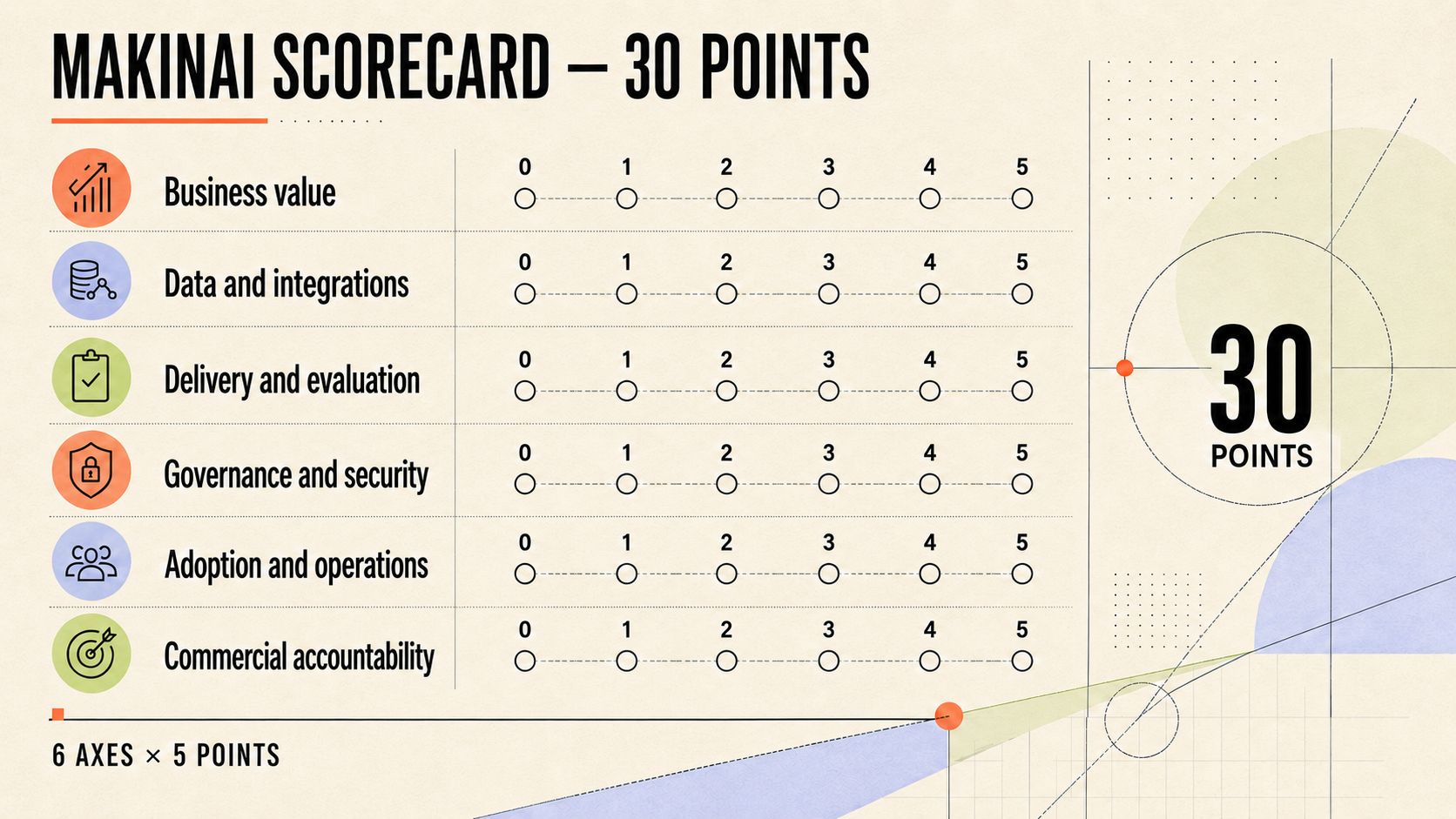
The safest way to choose a company to implement AI in Brazil is to score evidence — not pitch quality — across six dimensions: business value, data and integrations, delivery and evaluation, governance and security, adoption and operations, and commercial accountability. Each dimension is worth five points. The total guides comparison, but a critical privacy, security or accountability gap is a stop condition regardless of the score.
The MAKINAI 30-point scorecard
Give every candidate the same case, time box and evaluation panel. Score 0 when there is no verifiable evidence; 1 for intention only; 3 when process, owners and examples are demonstrated; and 5 when the capability is proven in your operating context with metrics, risks and an ownership plan. Do not round up for brand recognition.
- 1. Business value — connects a strategic priority to a use case, baseline, financial hypothesis, success metric and scale decision. Five points require a value thesis and executive owner; zero means a solution in search of a problem.
- 2. Data and integrations — maps sources, quality, permissions, APIs, architecture, cost and dependencies. Five points require a testable design for the real environment; zero means an isolated demo.
- 3. Delivery and evaluation — defines prototype, acceptance criteria, test sets, human evaluation, monitoring and failure handling. Five points require gates before production; zero relies on model fluency as proof of quality.
- 4. Governance and security — addresses Brazil’s LGPD, legal basis, minimisation, retention, access, vendors, intellectual property and incident response. Five points require controls and named owners; zero is a contracting stop.
- 5. Adoption and operations — redesigns work, trains users and defines support, SLAs, observability, cost and continuous improvement. Five points show who runs the system on day 91; zero ends at the pilot.
- 6. Commercial accountability — clarifies scope, assumptions, deliverables, asset rights, recurring costs, payment milestones and exit criteria. Five points align incentives to outcomes; zero transfers all risk to the client.
Choose the partner type before the partner name
- Strategy consultancy: best when the gap is prioritisation, governance, operating model or portfolio design.
- AI product studio: best when the company must discover, design and build a differentiated product or experience.
- Systems integrator: best when the dominant challenge is connecting platforms, data, identity, security and legacy processes at scale.
- Managed operator: best when monitoring, support, optimisation and continued evolution must remain with a partner.
- Hybrid: often the right answer, provided one party owns the outcome and contractual interfaces are explicit.
A strong provider in the wrong category is still a poor choice. Before issuing an RFP, define whether you are buying a decision, a product, an integration or an operating capability. International companies entering Brazil should also require local evidence for language, regulation, data flows, procurement and change management.
Evidence to require before signing
- An initial architecture covering data, models, integrations, controls, observability and ownership.
- A risk backlog with probability, impact, mitigation and owner — not only a principles slide.
- A short demonstration using a representative slice of the process and data, when legally permitted.
- An evaluation plan covering quality, safety, cost, latency, exception rate and human review.
- Comparable references whose scope and the provider’s actual role can be verified.
- An explicit transfer list for code, prompts, documentation, derived data, evaluations, infrastructure and knowledge.
Build, buy or partner: decide by capability
- Build when the capability differentiates the business, the data is strategic and a team can operate the system continuously.
- Buy when the process is standardised, speed matters more than differentiation and risk can be controlled through configuration and contract.
- Partner when the capability matters but product, engineering, governance or organisational change is still missing.
- Combine when commodity components can be bought while differentiated experience, data, evaluation and operations are built.
AI RFP red flags
- ROI promises made before understanding the baseline, adoption, operating cost and constraints.
- “Proprietary model” or “agents” used as answers to architecture, evaluation or accountability questions.
- Refusal to disclose dependencies, subprocessors, retention policies or how client data is used.
- A pilot proposal without a decision hypothesis, stop criteria and route to operation.
- A low entry price that excludes evaluation, observability, security, integration, support or model consumption.
- Case studies without context, numbers without method or performance claims that cannot be verified.
A 90-day pilot designed to produce a decision
- Days 1–15: confirm process, baseline, users, data, risks, value metric and no-go criteria.
- Days 16–45: build the smallest end-to-end experience with integration, access controls, evaluation and event logging.
- Days 46–70: operate with real users and measure exceptions, quality, cost, time saved, adoption and unintended effects.
- Days 71–90: decide whether to stop, repair or scale; produce target architecture, operating model, budget and control backlog.
How to read the result
- 0–14: high risk. The proposal depends on intention rather than demonstrated capability.
- 15–21: conditional potential. Require focused proof on weak dimensions before contracting.
- 22–26: viable partner. Put gaps, owners and decision gates into the contract.
- 27–30: strong fit — still subject to evidence in your environment and reference checks.
- Stop rule: a zero in governance and security, or an inability to confirm data use and retention, pauses procurement regardless of the total.
The best AI implementation partner is not the one promising the broadest transformation. It is the one that makes the next decision verifiable, transfers capability to the business and accepts responsibility for reaching operation.
Run the scorecard in a 60-minute session with business, technology, data, security, legal and operations. Record evidence and disagreements, not only the average. MAKINAI uses this principle to turn AI ambition into systems that can be built, operated and scaled in Brazil.