Direct answer: choose an AI product development company by its ability to prove six things before scale: a valuable problem exists, the interaction helps real people, model behavior is measurable, the system works under production conditions, the economics are sustainable and your organization can govern or take over the product. An impressive demo proves only technical possibility. Before hiring, require evidence, accountable owners and decision criteria for all six proofs.
AI products combine research, design, data, models, software, security, operations and process change. A strong partner does not treat these disciplines as a handoff sequence. It turns uncertainty into experiments, connects model metrics to user outcomes and decides early what should not be built. That behavior lowers the risk of funding a prototype that works in a presentation but fails with real users, data, volume, exceptions or costs.
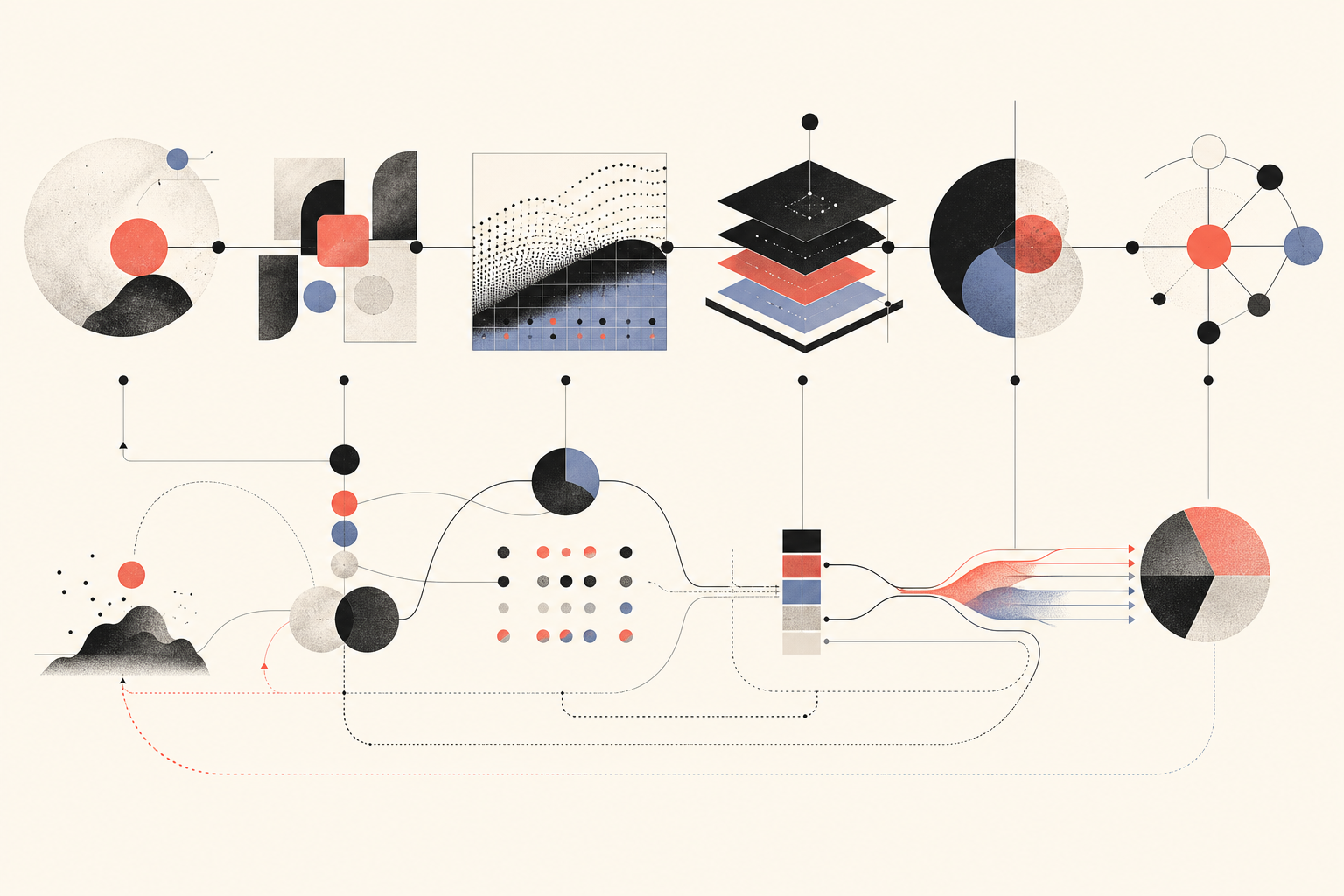
The MAKINAI Product Partner Proof-6
Compare proposals on the same six proofs: Problem, Interaction, Model, System, Business and Ownership. For every proof, request a hypothesis, method, evidence, known limit and next decision criterion. Partner quality appears less in the certainty of the promise than in how the team measures and reduces uncertainty.
1. Problem Proof: is it worth solving, and is AI necessary?
Discovery should begin with users, workflow, frequency, consequence of error and business outcome. UK government discovery guidance considers the phase complete when there is enough evidence to decide whether a viable, cost-effective service should proceed. Ask the provider for an explicit way to stop when evidence is weak. “Use AI” is not an outcome; reducing time, increasing capacity, improving a decision or enabling a previously impossible experience can be.
- Evidence: interviews and observation; current-journey map; baseline; priority tasks; value hypothesis; adoption risks; non-AI alternatives; success metric; proceed-or-stop decision. Red flag: the scope begins with a chatbot or model before defining the user and job.
2. Interaction Proof: can people understand, control and recover?
The experience must be designed for AI variability. Google’s People + AI Guidebook organizes practical guidance for human-centered AI products. Ask how the partner communicates capability and limits, gathers context, represents uncertainty, enables correction and provides fallback. A product is not trustworthy because its average response is good; it is trustworthy when a person knows what to do after an incomplete or wrong response.
Require prototypes tested with representative users, including different knowledge levels, languages and accessibility needs. Observe the complete task rather than the AI output screen. If a human must review, identify where review happens, how much effort it consumes and whether the reviewer receives enough evidence to decide.
3. Model Proof: is behavior measured in the real context?
The provider should translate quality into evaluations connected to the task: correctness, completeness, safety, consistency, refusal, source use, tool selection or another relevant criterion. NIST’s generative AI profile recommends lifecycle risk management. That requires a versioned evaluation dataset, difficult cases, critical segments, human review and a baseline against which changes can be compared.
- Evidence: failure taxonomy; held-out test set; rubrics; results by segment; adversarial tests; acceptance criteria; model, prompt and configuration records; regression process. Red flag: the partner shows only selected examples or one average score without an error distribution.
4. System Proof: does it work with integrations, volume and failure?
An AI product is still software. NIST SP 800-218A extends secure development practices for models and organizations acquiring AI systems. Evaluate architecture, identity, permissions, data, observability, queues, retries, versioning, tests, deployment and rollback. Require latency and cost estimates at multiple volumes and an explanation of which components can be replaced.
The production proof should include model downtime, API limits, missing data, slow responses, version changes and malicious input. The partner should demonstrate safe degradation: queueing, deterministic response, return to search, human handoff or suspension of an action. Architecture that describes only the happy path moves exception cost into your operations.
5. Business Proof: does value survive total cost?
Connect three metric layers: model behavior, task success and economic outcome. An accuracy improvement matters only when it changes completion, time, revenue, risk or cost to serve. The proposal should separate discovery, build, cloud, model, data, license, support, evaluation and evolution costs. It should state assumptions for volume, adoption, context size and human review.
Request low, expected and high scenarios with triggers for changing architecture or scope. Do not accept ROI based only on theoretically saved hours. Measure adoption, completed task, quality, net time including review, cost per valid outcome and side effects. The business case should support reducing or stopping investment when assumptions fail.
6. Ownership Proof: does your company control what is being built?
Define before contracting who owns code, designs, prompts, evaluation datasets, configurations, documentation, telemetry and learning. Ask how data and intellectual property enter model providers, what licenses apply and how portability works. Microsoft’s Responsible AI Standard translates principles into development requirements; a buyer should know which artifacts show that relevant requirements were met.
Require continuous repository access, infrastructure as code, decision records, runbooks and enablement. The provider may continue operating the product, but it should not remain the product’s only memory. Transfer is not an event at the end; it happens every cycle through joint work, review and explicit ownership.
Three gates that prevent a permanent prototype
Gate 1, Discovery: release prototype work only when the problem, user, risk and metric are clear. Gate 2, Proof: release a pilot only when interaction and model behavior are evaluated on representative cases. Gate 3, Production: release scale only when the system, economics, operations and ownership meet approved criteria. Every gate records one decision: proceed, adapt or stop.
How to score proposals
Assign zero to four points to every proof: zero means absent; one, a promise; two, a documented method; three, pilot evidence; four, reproducible production evidence. Require at least three in Problem, Model, System and Ownership before a broad engagement. Compare the actual team too: product leadership, research and design, engineering, data/ML, security and operations. Named people and availability matter more than a capability chart.
- Minimum outputs: problem map; prototypes and research; hypothesis backlog; evaluation dataset and report; architecture; threat model; observability plan; cost scenarios; gated roadmap; responsibility matrix; repository, documentation and transfer plan.
Red flags and next step
- The proposal promises a fixed timeline before discovery; a demo substitutes for research; UX follows the model; metrics never reach a user outcome; regression tests are absent; architecture covers one happy path; review and operating costs are excluded; artifacts remain vendor-only; transfer is a final-day workshop; the partner cannot explain when it would recommend stopping.
Use Proof-6 to request the same evidence from every bidder. Compare general capability with https://makinai.co/insights/en/how-to-choose-ai-implementation-company-brazil-scorecard and structure the procurement with https://makinai.co/insights/en/how-to-write-rfp-ai-services. For the technical and commercial path after a prototype, read https://makinai.co/insights/en/ai-prototype-to-product-scaling-monetization-roadmap. When strategy, experience, design and build must work together, visit https://makinai.co/services/en/branding-creative-digital-experience-agency.