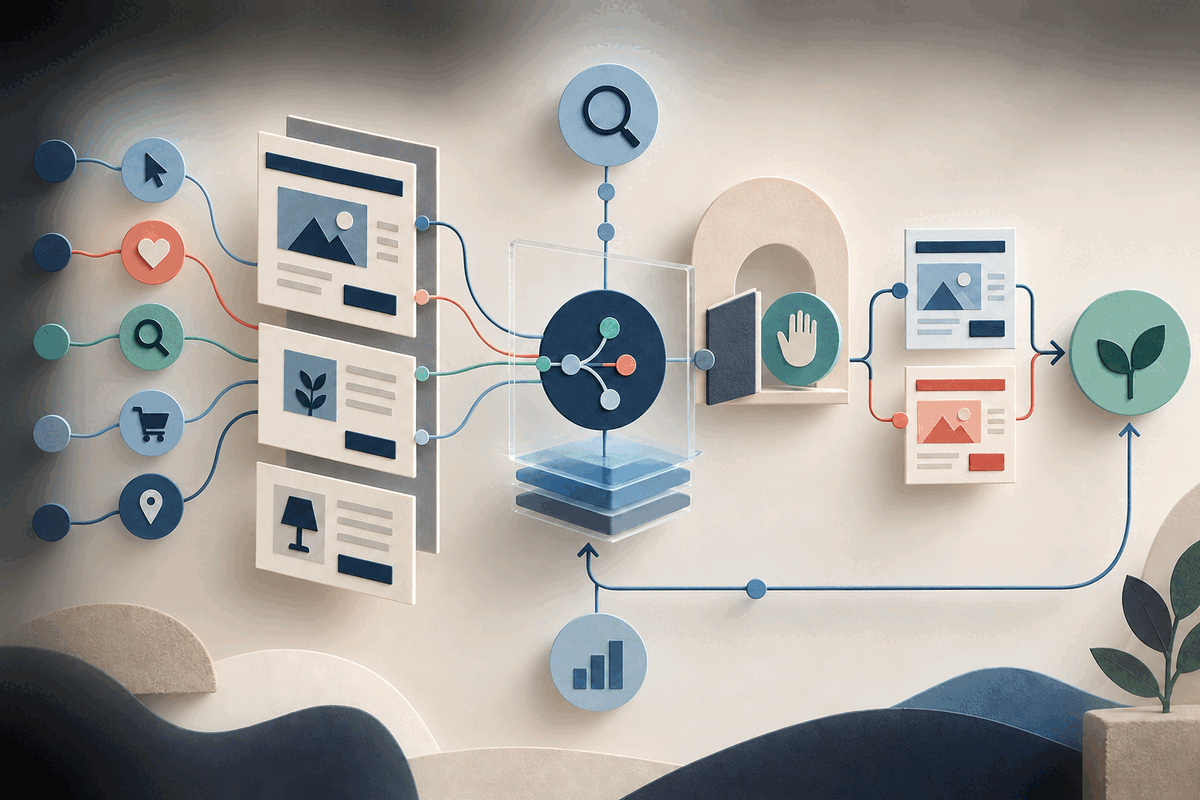
If your website gets traffic but does not convert, do not begin with a generic chatbot, personalization on every page, or a new CMS. Use AI for four bounded jobs: organize behavioral and research evidence, prioritize one friction point, produce a controlled intervention, and route each case to the right next step. Keep the current stack, measure the journey end to end, and prove the change with a controlled test when volume allows.
AI can find patterns, summarize sessions and feedback, propose hypotheses, adapt approved content, and classify intent. It cannot by itself prove why someone abandoned or whether a variant caused more revenue. A useful project links observation, decision, change, and a downstream CRM or commerce outcome. Without that chain, the company gets more content and dashboards, not necessarily more conversion.
Define conversion as a business outcome first
For ecommerce, the outcome may be contribution margin after cancellations and returns, not merely purchase. For B2B, it may be an accepted meeting, qualified opportunity, or contract, not a form fill. For services, it may be an attended appointment. The website event is a stage; evidence of value often arrives later. Google recommends events for sales and lead-generation journeys, including online and offline stages, but implementation and reconciliation remain the company's responsibility.
Choose one primary metric and two guardrails. A hypothetical example: increase completed bookings without increasing invalid inquiries or reducing attendance. Record the baseline, time window, and source. Do not optimize an easy metric such as time on page unless it represents the goal. The first project decision is what is worth improving, not which model to use.
The conversion evidence loop
- 1. Outcome — name the economic result and the window in which it appears.
- 2. Journey — define three to six observable stages, including a downstream outcome where possible.
- 3. Friction — combine quantitative signals, research, and operations to choose one point without presenting correlation as cause.
- 4. Intervention — create a reversible change in content, proof, form, recommendation, qualification, or routing.
- 5. Experiment — compare against control with guardrails and a stop rule; use controlled rollout when volume is limited.
- 6. Operation — document who approves, monitors, fixes, and decides to scale as models, offers, and behavior change.
The loop avoids two extremes: rebuilding the whole site from opinion, or allowing an AI system to change journeys continuously without knowing which change produced the result. The objective is to shorten the path from evidence to test without removing accountability.
Use AI in diagnosis, but preserve the trail to evidence
GA4 funnel exploration can show ordered stages, abandonment, elapsed time, segments, and next actions. Configuration matters: open and closed funnels count different journeys, and event order changes who appears at each stage. Before asking AI to identify bottlenecks, validate events, duplication, consent, cross-device behavior, and the funnel definition.
AI can then group abandonment reasons from tickets, chats, surveys, and sales notes; summarize navigation patterns; connect questions to stages; and create a hypothesis backlog with supporting evidence. Require each hypothesis to retain links or IDs to the observations behind it. An explanation without traceability remains a hypothesis.
Choose an intervention small enough to teach you something
If a B2B solution page is the suspected problem, an intervention might reorder proof and use cases for a known industry without inventing claims. If a form is the issue, it might remove questions, prefill authorized fields, or route low-confidence submissions to review. In ecommerce, it might explain compatibility, delivery, or returns from approved catalog data. Keep a fallback and a stable version in every case.
Do not personalize everything. More combinations mean smaller samples, more QA, and weaker attribution. Begin with two or three segments that change a real decision. Use deterministic rules when sufficient; use classification or generation when variability earns the added complexity. A credible partner should recommend no AI when content, performance, or a rule solves the problem better.
Test the effect; do not let AI pick its own winner
Research on online experiments shows that plausible intuitions about A/B tests can mislead. Before launch, define the randomization unit, exposure, primary metric, guardrails, minimum duration, exclusions, and decision rule. Check sample ratios, telemetry, and parallel changes. Do not stop when a dashboard turns positive or present a post-hoc segment as the original hypothesis.
When volume cannot support a trustworthy A/B test, use staged rollout, cautious pre/post comparison, qualitative evidence, and operational thresholds. State the causal limitation. For a long sales journey, keep leading indicators, but wait for the CRM outcome before declaring return.
A six-week engagement a buyer can scope
- Week 1: outcome definition, baseline, journey, and event-quality review.
- Week 2: synthesis of research, feedback, and operations; selection of one friction point.
- Week 3: intervention design, guardrails, approved content, fallback, and test plan.
- Week 4: implementation in the existing CMS or delivery layer, minimum integration, and QA.
- Week 5: shadow mode or limited exposure, event reconciliation, and fixes.
- Week 6: experiment or rollout start, operating dashboard, and decision to keep, revise, or remove.
Six weeks is a scope container, not a universal promise. Low traffic, vendor dependencies, legal review, site performance, fragmented identity, or a long sales cycle may require another window. Deliverables should include the journey map, event dictionary, prioritized backlog, intervention logic, assets, configuration or code, test cases, experiment plan, monitoring, and operating documentation.
Responsibilities and cost drivers
Marketing owns the outcome and hypotheses. Product or UX protects the journey. Analytics defines events and interpretation. Engineering integrates and preserves performance. CRM, sales, or commerce returns the downstream result. Legal and privacy teams review applicable data use. The agency or consultancy must own the complete flow or make handoffs explicit. NIST's lifecycle approach supports governance, measurement, evaluation, and monitoring; a launch without an operating owner is incomplete.
Cost depends on the number of journeys and variants, telemetry quality, CMS access, content volume, CRM or commerce integration, identity, languages, traffic, experimentation tooling, consent requirements, QA, monitoring, and support. Price diagnosis, build, and operation separately. Do not buy a quantity of generated variants; buy a safe learning capability.
Bring one real journey to the first conversation
Start with the 90-day plan at https://makinai.co/insights/en/where-start-ai-marketing-90-day-first-workflow. Connect acquisition through https://makinai.co/insights/en/paid-media-ai-beyond-google-meta-automation, downstream value through https://makinai.co/insights/en/ai-lead-qualification-marketing-sales-handoff, and customer evidence through https://makinai.co/insights/en/choose-ai-customer-research-ux-consultancy. MAKINAI combines digital experience, creative, data, and implementation: https://makinai.co/services/en/branding-creative-digital-experience-agency. Bring one journey, a 30-day baseline, and an anonymized sample of questions or abandonment reasons. We can discuss which friction deserves a pilot and whether it actually needs AI.
The sources describe analytics capabilities, events, risk practices, and experimentation limits. They do not show that AI will improve a particular site's conversion. The loop, scope, and examples are MAKINAI editorial recommendations and require validation against each company's technical, commercial, and regulatory context.