Agentic commerce, in one paragraph
Agentic commerce is a commerce model in which an autonomous software agent researches options, evaluates trade-offs, selects a product or service, completes the transaction and manages permitted post-purchase tasks on behalf of a user. Unlike traditional e-commerce and marketplaces, it does not require the buyer to browse every option and operate the checkout. Unlike most conversational commerce, it can receive delegated authority to act without requesting approval at every step. The agent remains bounded by user-defined policies covering factors such as budget, brands, delivery times, payment methods and situations that require human confirmation.
The defining change is therefore not a new shopping interface. It is the transfer of limited decision and execution authority from the buyer to software. Value shifts from pages, menus and search boxes toward agent reliability, verified intent, accessible product data, delegated payments, audit trails and effective recourse when something goes wrong.
Why agentic commerce matters now
Shopping assistants have existed for years, but several capabilities are beginning to converge. Large language and multimodal models can interpret loosely specified goals and product information. APIs and automation tools can connect reasoning systems to catalogs, inventory, checkout and order management. Payment networks are developing infrastructure that distinguishes authorized agents from malicious bots and binds transactions to customer intent.
Visa describes agentic commerce as experiences in which AI agents help people or businesses discover products, make decisions and complete parts of a purchase. Its Intelligent Commerce materials emphasize tokenized credentials, authentication, payment instructions and signals that validate a transaction against consumer intent. Mastercard similarly frames trust around explicit permissions, verifiable agent identity, tokenization and an auditable record of decisions. These developments do not mean the model is mature everywhere, but they show that agent-initiated payments are moving from hypothetical demonstrations toward controlled commercial infrastructure.
For users, the principal problem being addressed is the cost of coordination. A purchase may require searching multiple sources, normalizing incompatible specifications, monitoring prices, completing forms and later tracking or returning the order. An agent can reduce this workload when the user’s objective and constraints can be expressed clearly enough to support delegation.
How agentic commerce differs from existing commerce models
- Traditional e-commerce — The customer searches, compares, selects and checks out. Personalization may rank products, but the human remains the operator and decision-maker.
- Marketplaces — A platform centralizes offers and transactions from multiple sellers. An agentic system may work across several marketplaces, merchant sites and direct APIs rather than remaining inside one platform.
- Subscription commerce — The customer authorizes repeat delivery or access under a predefined schedule. An agent can reassess whether to reorder, pause, change suppliers or switch plans as circumstances change.
- Conversational commerce — A chatbot or voice assistant helps the customer find information and navigate a flow. It often waits for step-by-step instructions or final human confirmation.
- Programmatic purchasing — Software automatically buys inventory, advertising or other predefined resources according to machine-readable rules. It is automated, but generally optimized around a specialized market mechanism rather than a broad user purchasing goal.
- Agentic commerce — The user defines an outcome and decision envelope. The agent plans and executes multiple stages, potentially across providers, while preserving controls, traceability and escalation paths.
A conversational interface can be part of agentic commerce, but conversation alone does not make a system agentic. The practical test is whether the software can progress from a goal to a completed and governed outcome, rather than merely recommending the next action for a person to take.
The seven components of an agentic commerce stack
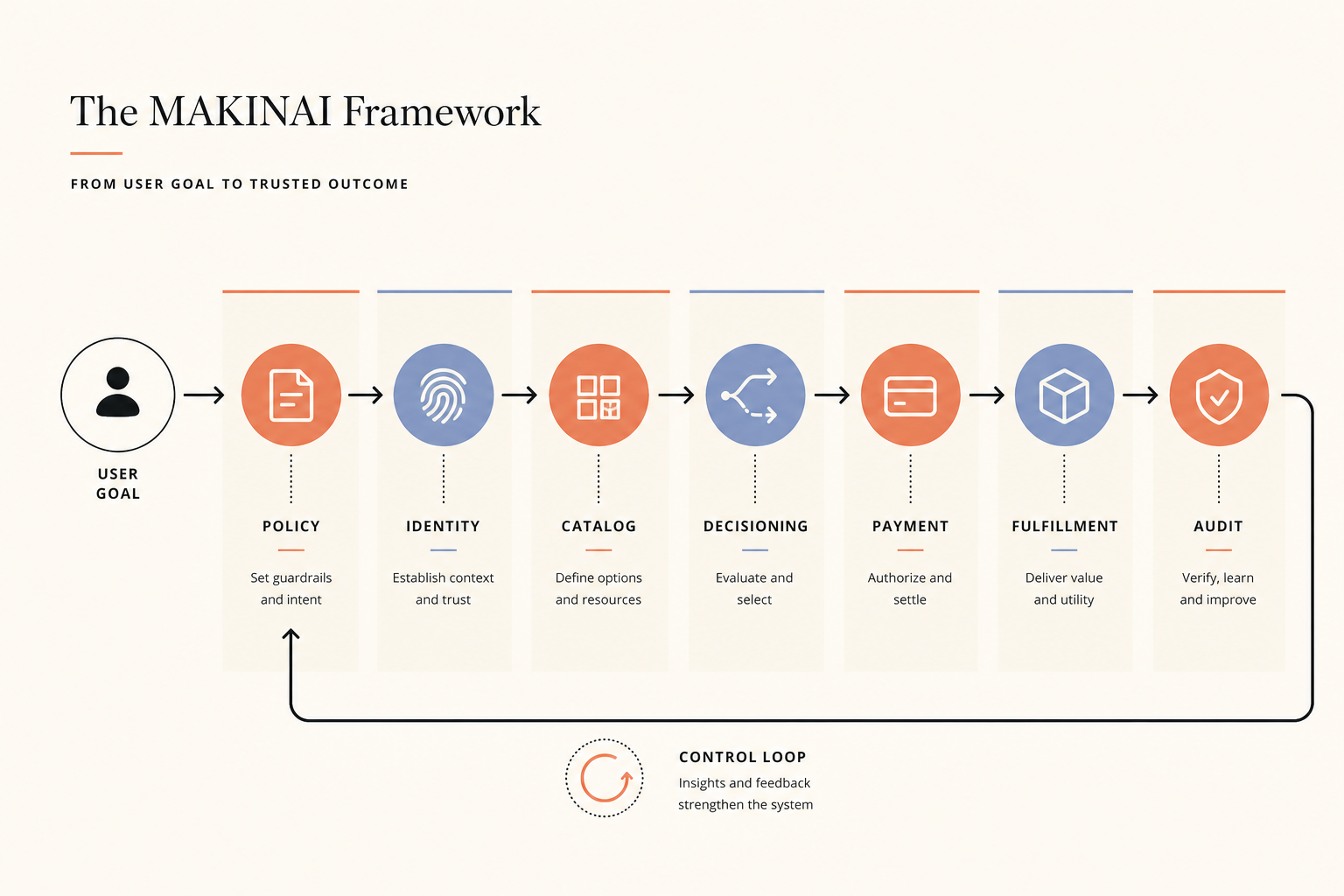
A production stack needs more than a capable model. It must connect judgment, authority and transaction execution through seven coordinated layers.
- 1. Agent orchestration and policy — Translates the user’s goal into tasks and defines budgets, approved suppliers, prohibited actions, confidence requirements and escalation rules.
- 2. Identity, consent and delegation — Associates the agent with a verified user or organization and records what it has permission to do, for how long and under which conditions.
- 3. Catalog and availability access — Supplies normalized product attributes, provenance, live prices, stock, delivery terms and merchant policies across relevant sources.
- 4. Decisioning and ranking — Evaluates options against multiple criteria such as price, performance, warranty, timing, sustainability and existing preferences, while producing an understandable rationale.
- 5. Payments and settlement — Provides tokenized or otherwise protected credentials, agent authentication, spend controls, merchant routing, refunds and fraud monitoring.
- 6. Transaction and post-purchase orchestration — Places the order, monitors fulfillment and manages permitted cancellations, returns, replacements or disputes.
- 7. Auditability, safety and control — Records inputs, decisions and actions; enables overrides and revocation; and supports testing, monitoring and incident response.
Tokenization is important but not sufficient. PCI Security Standards Council guidance explains how tokens can replace primary payment account data within a tokenization system and potentially affect PCI DSS scope. Agentic commerce adds another requirement: the ecosystem must also know who delegated the transaction, what the agent was authorized to buy and whether its action remained inside that mandate.
Autonomous agent or guided assistant? Use five capability thresholds
Teams should avoid labeling every AI shopping feature as autonomous. The following thresholds create a more useful product classification.
- Authority — Can the system complete a transaction inside a predefined policy without asking for final approval? If not, it is primarily an assistant.
- Persistence — Can it retain and appropriately update preferences, policies and relevant context across sessions? A single-session recommendation tool has limited agency.
- Reach — Can it compare and execute across multiple permitted sources, or is it restricted to one catalog and one fixed flow?
- Remediation — Can it detect a failed payment, unavailable product or delivery problem and take an approved corrective action?
- Accountability — Can users and operators inspect why an option was selected, which data was used and which actions occurred?
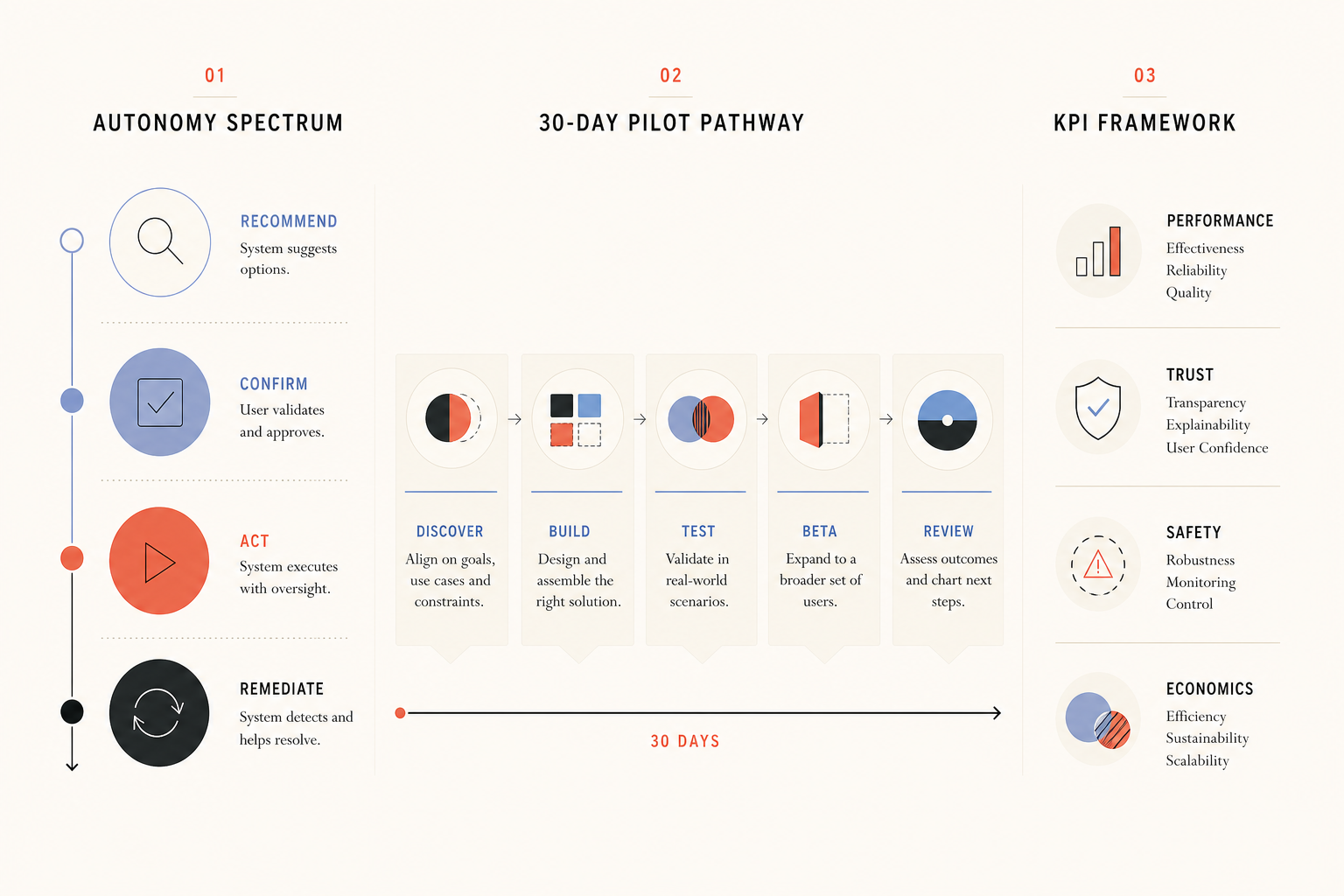
Autonomy should be treated as a configurable spectrum, not a binary achievement. A customer might permit automatic purchases below $50 from approved sellers, require confirmation for substitutions and prohibit international transactions. The strongest design is not the agent with the most freedom; it is the agent whose authority matches the risk and reversibility of the task.
Where early agentic commerce pilots are most likely to work
Good initial use cases have repeatable demand, measurable criteria, bounded financial exposure and recoverable errors. They do not require the agent to infer highly subjective preferences from limited evidence.
- Replenishment — Household staples, pet supplies and office consumables have recurring demand and relatively stable specifications. The agent can monitor need, price and availability while respecting substitution rules.
- Low-value business procurement — Approved vendor lists, budgets and audit requirements create a clear policy environment for routine purchases.
- Subscription optimization — An agent can monitor renewal dates, usage and approved alternatives, then recommend or execute cancellation, downgrade or switching actions.
- Specification-led products — Electronics, equipment and parts can work when compatibility, delivery and warranty requirements are explicit.
- Travel and ticketing — Agents can create value by coordinating dates, budgets and availability, although cancellations, dynamic prices and complex supplier rules increase operational risk.
- Premium concierge journeys — Existing trust relationships can support delegation, provided high-value transactions have strong approval and recourse controls.
Avoid beginning with regulated goods, irreversible transactions, highly emotional purchases or categories where inaccurate product data could cause physical harm. Legal and compliance teams should review the selected market, category, payment flow and allocation of liability before launch.
A practical 30-day pilot structure
Start with one journey, one user segment and a narrow catalog. The objective is not to demonstrate unlimited autonomy. It is to learn whether the organization can safely connect intent, decisioning, payment and remediation.
- Days 1–5: Map the journey, integrations, failure modes and regulatory constraints. Define the agent’s decision envelope and confirmation thresholds.
- Days 6–12: Connect a controlled catalog and sandbox or tokenized payment environment. Build logs for prompts, policies, source data, decisions and tool actions.
- Days 13–20: Run internal scenarios, including unavailable stock, price changes, duplicate orders, payment rejection, delayed fulfillment and refund requests.
- Days 21–26: Release an opt-in beta to a small group with spend caps, clear disclosures and rapid human support.
- Days 27–30: Review failures, overrides, user feedback and unit economics. Decide whether to narrow, redesign, expand or stop the experiment.
The core measures should include agent transaction completion rate, time to purchase versus a manual baseline, user override rate, incorrect or unauthorized action rate, remediation success, satisfaction and trust. Commercial metrics can include conversion, retained revenue, procurement savings or support cost, depending on the use case. Every metric should be segmented by journey and failure type; a single average can hide serious weaknesses.
NIST’s AI Risk Management Framework offers a useful governance structure for this work through four continuous functions: govern, map, measure and manage. Applied to agentic commerce, that means assigning accountability, mapping users and harms, measuring system behavior and maintaining responses for identified risks throughout the lifecycle.
Business models, partnerships and strategic trade-offs
Potential models include a user subscription, a merchant platform fee, a premium concierge charge or a disclosed commission on completed transactions. Each creates different incentives. Commission-based ranking can undermine trust if commercial considerations are not separated from user preferences. Subscription models align more directly with the buyer but may be difficult to justify for infrequent purchases.
Merchants must also decide how much of the relationship to expose to external agents. Open catalog and order APIs can increase discoverability, but they may reduce control over the interface and weaken conventional merchandising tactics. Closed experiences protect the storefront while limiting cross-source comparison. The strategic question is not simply whether to support agents, but which data, actions and commercial rules should be available to which verified agents.
The primary risks to resolve before scaling
- Authority and fraud — Stolen credentials or manipulated agents could generate unauthorized purchases. Use revocable delegation, protected payment credentials, spend limits and anomaly monitoring.
- Incorrect intent — A technically valid transaction may still violate what the customer meant. Preserve the original mandate and validate actions against it.
- Privacy — Persistent agents can accumulate sensitive preference and behavioral data. Minimize collection, separate purposes and make consent revocable.
- Liability and consumer protection — Contracts and operating procedures must clarify responsibility for inaccurate data, unsuitable recommendations, transaction errors, returns and disputes.
- Catalog manipulation — Merchants or third parties may optimize data to influence agent ranking. Track provenance and distinguish commercial signals from decision criteria.
- Operational fragility — APIs fail, prices change and inventory disappears. Agents need bounded remediation and reliable handoff to humans.
A proposed MAKINAI Feasibility Pack
Before committing to a scaled build, organizations can request a MAKINAI agentic commerce Feasibility Pack as a proposed scoped engagement. Its final contents, delivery period and price should be confirmed during review rather than treated as an existing standardized product.
The pack should include a technical feasibility audit, a tailored agent policy template, an integration checklist spanning identity, catalog, payments and order management, and a 30-day pilot blueprint with metrics, safety gates, dependencies and estimated cost. To prepare it, the organization would provide relevant architecture documentation, sample APIs, current checkout and post-purchase flows, and a shortlist of priority categories.
The immediate decision is not whether agentic commerce will replace every interface. It is whether one bounded journey can create enough user value to justify delegated action—and whether the organization can make that action reliable, transparent and reversible. MAKINAI can help define, build, implement and operate that first controlled experiment, then use the evidence to decide what should scale.