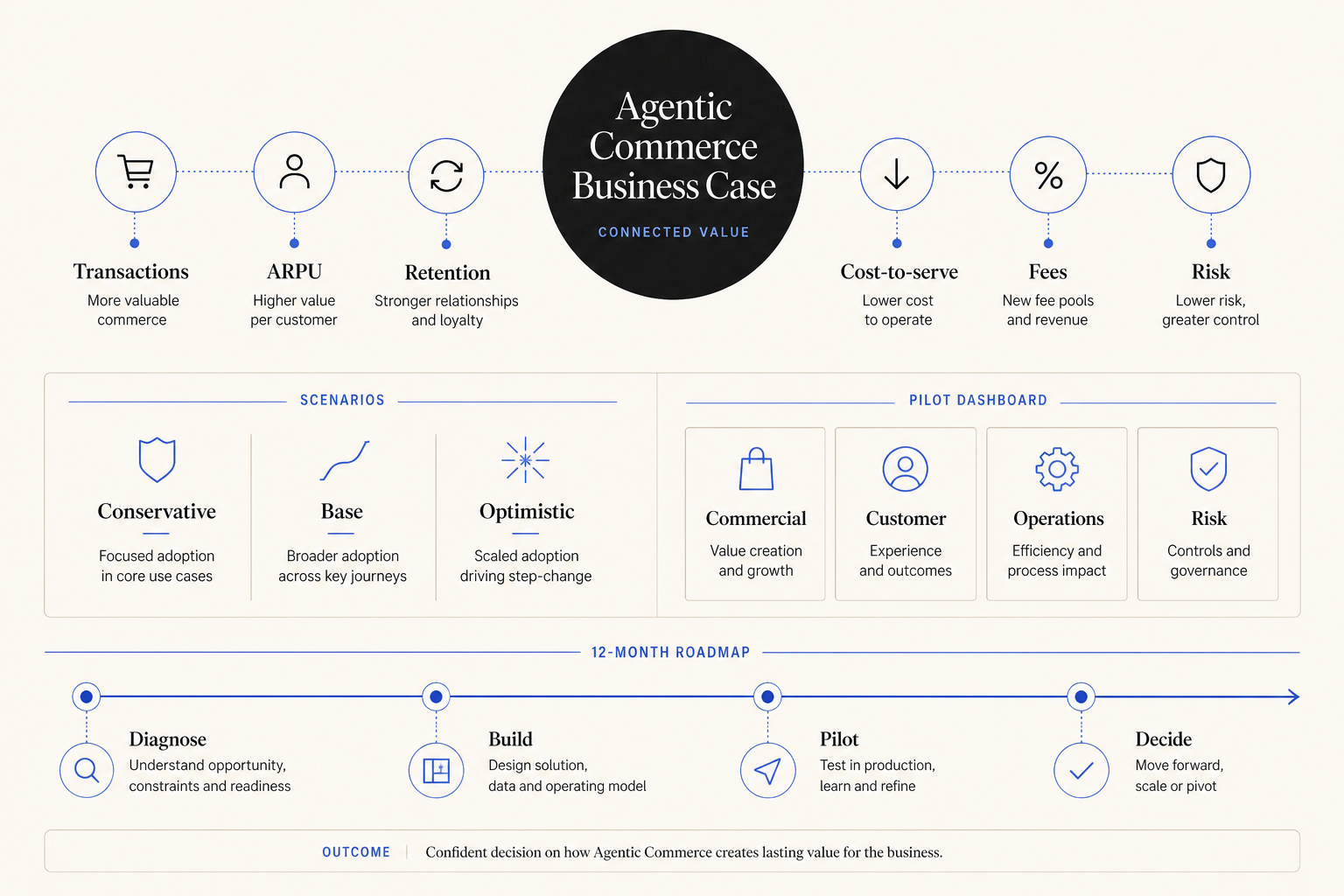
Evaluate agentic commerce with a compact model covering incremental gross merchandise value (GMV), average revenue per user (ARPU), retention and customer lifetime value (CLV), cost-to-serve, fee revenue and risk. Prioritize time-constrained, high-frequency or high-value customers; test the proposition through a controlled three-to-six-month pilot; and set financial, customer and risk thresholds before development begins. Before committing significant roadmap budget, run the MAKINAI Proprietary Agentic Commerce Financial Diagnostic as a structured analysis of your internal transaction, customer and cost data. The output should be decision-grade scenarios—not a generic market forecast—showing when to scale, pivot or stop.
What belongs in an agentic commerce business case?
Agentic commerce enables artificial intelligence agents to research, compare, purchase and sometimes manage products or services on a customer’s behalf. Its business case cannot rest on engagement or novelty. It must show how delegated purchasing changes transaction volume, customer economics and operating costs after payments, fraud, disputes and human oversight are included.
The model should compare an agentic journey with the relevant standard journey. That baseline matters: an agent may appear productive while merely shifting orders from an existing channel. The commercial question is whether it creates incremental value, protects strategically important demand or delivers the same outcome at a lower total cost.
Agentic commerce value = incremental contribution margin + retention value + fee revenue − technology, service and risk costs.
Use contribution margin rather than GMV alone. More orders do not necessarily create more value if agents select lower-margin products, increase substitutions or returns, attract incentives, or create expensive disputes. Build conservative, base and optimistic scenarios, but treat every adoption and uplift assumption as a variable to validate—not as a forecast.
Six value drivers to model first
- Incremental transactions: Orders created by higher conversion, recovered abandonment or new purchase occasions. Exclude channel migration unless it produces a measurable economic benefit.
- ARPU change: Revenue per user may rise through greater purchase frequency, larger baskets or relevant cross-selling. It may fall if agents consistently optimize for lower prices.
- Retention and CLV: Delegation may make a platform more useful and harder to replace, but trust failures can have the opposite effect. Model repeat purchasing and contribution margin over comparable periods.
- Cost-to-serve delta: Include model usage, infrastructure, merchant integrations, payment processing, customer support, human review, returns, disputes and ongoing control operations.
- Take rate or fee revenue: Test subscriptions, transaction fees, merchant funding or shared savings without assuming that customers or merchants will accept them.
- Risk and compliance cost: Account for fraud losses, chargebacks, reserves, legal review, monitoring, consent management and remediation.
Finance teams should calculate results at order, customer and segment levels. At minimum, the model needs twelve months of order-level transactions, average order value, product or service margin, returns, disputes, current take rates, acquisition and retention patterns, and a defensible cost-to-serve breakdown. If those inputs are incomplete, label the gaps explicitly and use ranges rather than false precision.
Which customer segments should an agentic commerce pilot target?
The strongest pilot segment is not necessarily the largest audience. It is the group with a valuable problem, sufficient transaction frequency and a willingness to delegate within clear rules. Prioritize segments by economic potential, task suitability, data readiness and risk.
- High-intent, time-constrained shoppers: Customers considering complex purchases such as electronics, travel or cross-border orders may value research and comparison support. Start with bounded tasks before autonomous payment.
- Repeat, frequency-driven buyers: Reorders and consumables offer predictable requirements and frequent opportunities to measure convenience, retention and cost.
- Small and medium-sized business procurement: Rules-based purchasing, approval limits and repeat supplier orders can create clear operational value, provided identity, authorization and audit requirements are addressed.
- Affluent or concierge customers: High-ARPU users may pay for premium sourcing or service guarantees, but their expectations and recovery costs can also be higher.
Size the near-term opportunity from the inside out. For each segment, multiply the number of eligible active buyers by an explicit adoption assumption, expected agentic order frequency and incremental contribution per order. The brief’s 1–5% early-adoption range can be used as a sensitivity input, not as an external benchmark; it must be replaced or validated through invitation acceptance, activation and repeat-use data from the pilot.
Also estimate cannibalization. Separate genuinely incremental orders from purchases that would have occurred through search, marketplace, app or store journeys. Incremental CLV should be calculated from changes in retained contribution margin, not from gross revenue attributed to agent users.
How to design a three-to-six-month agentic commerce pilot
The pilot should test a narrow purchasing job, a defined cohort and a limited merchant or product scope. Examples include replenishing previously purchased items within a spending limit or producing a shortlist that requires approval before payment. Expanding autonomy should be earned through evidence.
Use a randomized control trial (RCT) where practical, or a carefully matched cohort when randomization is not feasible. Determine sample size using baseline conversion, expected detectable change and the organization’s statistical confidence requirements. Do not select an arbitrary sample and interpret directional movement as proof.
- Primary commercial KPIs: Incremental GMV, incremental contribution margin, conversion lift, ARPU delta, purchase frequency and 30- or 90-day repeat purchase rate.
- Customer KPIs: Agent activation, task completion, override rate, repeat agent use, satisfaction or NPS, and trust-related abandonment.
- Operating KPIs: Cost-to-serve per completed order, model and infrastructure cost, human escalation rate, average handling time, fulfilment failure and return rate.
- Risk KPIs: Unauthorized transaction claims, fraud, disputes, chargebacks, policy violations, consent revocations and harmful substitution events.
- Monetization KPIs: Subscription conversion, fee acceptance, take-rate revenue, incentive cost and merchant-funded revenue.
Three months may reveal conversion, completion and ARPU signals. A longer observation window is usually needed to assess repeat behavior, retention, disputes and returns. Pre-agree gates before launch: pause if unit economics exceed the approved loss threshold, fraud or disputes breach risk tolerance, consent controls fail, or legal review identifies unacceptable exposure. Threshold values must be set from internal baselines and the target market’s requirements.
Pricing and incentive models worth testing
Pricing should align the party receiving value with the party paying. Test a small number of understandable options rather than combining several fees in the first experience.
- Consumer subscription: A recurring fee for premium sourcing, speed, controls or service guarantees. It creates predictable revenue but requires recurring value.
- Per-transaction fee: A fixed or percentage fee for an agented order. It is easy to attribute but may discourage frequent use or conflict with a savings proposition.
- Merchant co-funding: Merchants pay when an agent demonstrably generates incremental sales. Attribution, neutrality and disclosure require careful governance.
- Shared savings or rebates: The customer and platform share negotiated value. The calculation must be transparent and should not encourage unsuitable recommendations.
- Pilot incentives: Trial credits or temporary fee waivers can reduce adoption friction, but results must distinguish subsidized behavior from durable demand.
Operational and regulatory costs can change the answer
An agent that recommends a product is materially different from one authorized to pay. The business case must specify where the agent sits on that spectrum and what happens when a decision is ambiguous, a merchant changes availability or the customer disputes the outcome.
- Payments and liability: Define how credentials are tokenized, who authorizes each transaction, whether the agent acts as a proxy, and where liability sits. Escrow may be relevant in some models, subject to legal and payments review.
- Consent and privacy: Capture explicit, revocable permission. Minimize stored data, define memory boundaries and give users access to action logs.
- Fraud and disputes: Add transaction monitoring, spending limits, anomaly detection, human escalation and reserve assumptions to the operating model.
- Merchant integration: Establish reliable price and availability data, substitution rules, cancellation and return processes, and service-level expectations.
- Brand and customer experience: Explain why an action was taken, allow override or approval, and provide a clear fallback when an agent cannot complete the task.
Applicable payments, privacy, artificial intelligence and consumer-protection rules vary by jurisdiction and operating model. Legal and compliance teams should verify the proposed permissions, disclosures and liability structure before live transactions begin.
A practical 12-month agentic commerce roadmap
- Months 0–2—diagnose: Define the customer job, collect baseline data, map authorization and liability, and build conservative, base and optimistic financial scenarios.
- Months 3–5—build and prepare: Develop the minimum viable flow, instrument events, connect a limited merchant set, implement consent and risk controls, recruit the cohort and finalize experiment design.
- Months 6–9—run the pilot: Ramp from invited beta users, compare against the control, test selected pricing models and review commercial, customer, operating and risk metrics together.
- Months 10–12—make the decision: Scale, pivot, restrict or sunset the capability against pre-agreed thresholds. If scaling, prioritize merchant coverage, operations automation and control maturity.
The roadmap should have named owners across Commerce, Product, Finance, Technology, Data, Operations, Legal and Risk. A single scorecard should connect customer behavior to unit economics so that making progress does not become confused with shipping more features.
The leadership go, no-go and conditional-scale checklist
- Go: Unit economics are positive at a credible adoption level; contribution and retention improve; risk remains within tolerance; and there is a viable regulatory and merchant path.
- No-go: Margins remain negative across plausible scenarios; autonomous payment creates unresolved compliance exposure; trust or dispute outcomes are unacceptable; or merchants reject essential operating terms.
- Conditional scale: Evidence is positive for a specific segment, category or region, but broader rollout depends on closing defined integration, control or service gaps.
The MAKINAI Proprietary Agentic Commerce Financial Diagnostic should be treated as a structured method requiring verification against each company’s data—not as a pre-existing ROI claim. Using twelve months of transactions, customer segments, cost-to-serve, take rates, returns and dispute data, the proposed diagnostic would establish the baseline, model adoption and cannibalization, calculate contribution under multiple scenarios, stress-test risk costs and recommend a pilot budget and decision gates.
For teams considering agentic commerce within the next twelve months, the practical next step is to approve data access and accountable owners for that analysis. MAKINAI can run the diagnostic as a two-to-three-week engagement, subject to confirming data readiness and scope, and translate the findings into a customized pilot recommendation. The objective is restrained but consequential: invest only where autonomous purchasing can produce measurable value without compromising customer trust, regulatory obligations or brand safety.