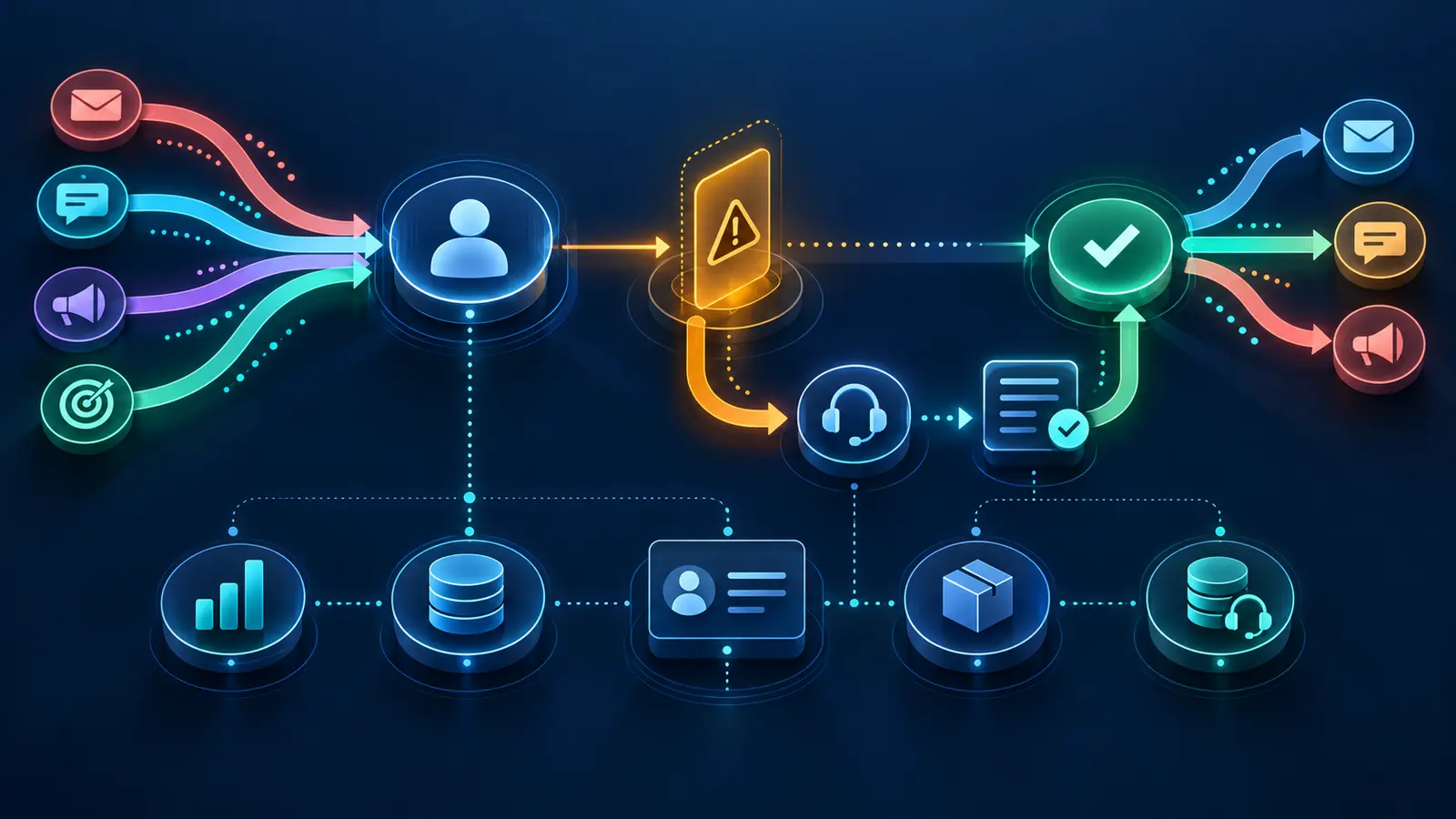
The direct answer: do not start with an AI-written apology or a churn score. First build a service-aware contact gate across support cases, orders, accounts, CRM, and channels. Hard rules pause promotions during critical unresolved incidents; AI classifies text, estimates urgency, and proposes the next safe action only where structured state is insufficient. Resume outreach at an explicit recovery milestone, not merely because an agent closed the case.
The failure occurs when marketing, sales, and service run on different clocks. A campaign was scheduled yesterday, the customer opens a billing dispute today, and the promotional SMS still leaves this afternoon. The automation can be technically correct and commercially wrong. The project must decide, by person, account, order, and incident, which contact remains appropriate.
Write the Customer Recovery Contact Contract
- Unit — person, account, order, contract, and incident covered by the decision.
- Class — delay, billing, defect, outage, fraud, cancellation, or complaint.
- Severity — criticality, exposed value, recurrence risk, and operational impact.
- Evidence — structured status, text, event, owner, last update, and confidence.
- Scope — channels, journeys, and offers that pause, adapt, or continue.
- Safe action — suppress, wait, inform, route, recover, or resume.
- Exceptions — transactional alerts, safety, required notices, or customer-requested information.
- Recovery milestone — confirmed delivery, received refund, accepted resolution, or no recurrence window.
- Fallback — human review, neutral message, or block when state is stale.
- Owner and outcome — who decides, who fixes, and how experience, revenue, and error are measured.
The Contract separates three decisions that teams often collapse: service may finish a task; the customer may not yet regard the issue as resolved; and marketing may or may not be ready to resume offers. Case closure is an event, not proof of recovery.
Connect state before adding AI
- Identity — contact, account, order, and case linked through an auditable rule.
- State — open, customer-pending, company-pending, resolved, reopened, and age.
- Context — channel, product, value, history, and actual service capacity.
- Contact — scheduled campaigns, active journeys, sales tasks, and transactional messages.
- Outcome — resolution, reopen, complaint, opt-out, purchase, retention, and contribution.
HubSpot documents workflows that associate tickets and contacts through compatible properties; Zendesk documents webhooks triggered by ticket and user events. Those capabilities make integration possible, but they do not automatically resolve shared accounts, stale data, or multiple cases describing one incident. Reconciliation and precedence remain design decisions.
Choose technology proportional to the available state
- Structured rules — enough when severity, status, and association are reliable.
- Native workflow — appropriate when service and marketing share a platform and latency.
- Integration layer — required when help desk, CRM, commerce, and messaging hold different states.
- Text classification — useful when cause, urgency, and intent are poorly coded; run it in shadow mode first.
- Predictive model — only when volume, alternative actions, and historical outcomes justify maintenance and monitoring.
Dynamic suppression lists, such as those documented by Braze, can remove people from campaigns and journeys while preserving tag-based exceptions. A global list can also block useful communications. Explicitly distinguish promotional, transactional, requested, safety-related, and recovery messages.
An eight-week implementation pilot
- Weeks 1–2 — select one incident class, one journey, and one market; baseline inappropriate contacts, complaints, opt-outs, reopens, and post-resolution conversion.
- Week 3 — reconcile case, contact, account, order, and scheduled campaigns.
- Week 4 — run the gate in shadow mode and review false blocks and false releases.
- Week 5 — activate hard suppression and fallback in one journey without AI-generated messaging.
- Weeks 6–7 — test limited classification or next-safe-action support with human review and a comparator.
- Week 8 — decide whether rules are enough, which integrations should scale, and where AI earns its complexity.
Measure recovery without hiding the commercial cost
- Safety — promotions sent during critical incidents, false releases, and stale state.
- Experience — complaints, opt-outs, reopens, time to accepted resolution, and satisfaction.
- Commercial — post-recovery conversion and contribution, retention, and preserved revenue.
- Operations — identity coverage, event delay, overrides, human queue, and review hours.
- Counter-metrics — lost reach, valid contacts suppressed, and opportunities deferred.
- Incrementality — preserve a rule or rollout comparator; fewer messages do not prove retention or revenue.
In the United States, begin with a workflow where email, SMS, in-app messaging, sales tasks, and support compete for the same customer—for example, a billing dispute or service outage. Do not copy sensitive case text into the marketing platform; publish only the minimum decision state. Consent, contractual, industry, and state requirements need local review.
Cost, accountability, and limits
Cost rises with help desks, CRMs, channels, countries, languages, shared accounts, volume, refresh frequency, 24/7 operations, and human review. Service owns incident and recovery; CRM governs contact and exceptions; marketing owns journey and offer; sales respects the gate; data reconciles identity and outcomes; technology integrates events; privacy and legal review usage; finance estimates value preserved. NIST's Core emphasizes governing, mapping, measuring, and managing risk throughout the lifecycle.
Bring one real incident to the diagnostic
Connect this project to customer-conversation signals at https://makinai.co/insights/en/ai-sales-support-conversations-marketing-decisions, journey QA at https://makinai.co/insights/en/ai-test-broken-crm-customer-journeys, next-best-action at https://makinai.co/insights/en/ai-next-best-action-crm-personalization, and preventable churn at https://makinai.co/insights/en/ai-preventable-churn-early-warning-retention. MAKINAI implements CRM and commerce at https://makinai.co/services/en/crm-ecommerce-commerce-transformation. Bring one incident class, the current journey, and four weeks of cases, messages, and outcomes; we can define the smallest useful pilot.
The pilot does not guarantee retention or revenue. Sentiment can be misclassified, a closed case can hide dissatisfaction, suppression can remove valid demand, and service capacity can remain the bottleneck. The sources support associations, events, suppression, and continuous controls; the Contract and pilot design are MAKINAI editorial recommendations to validate in operations.