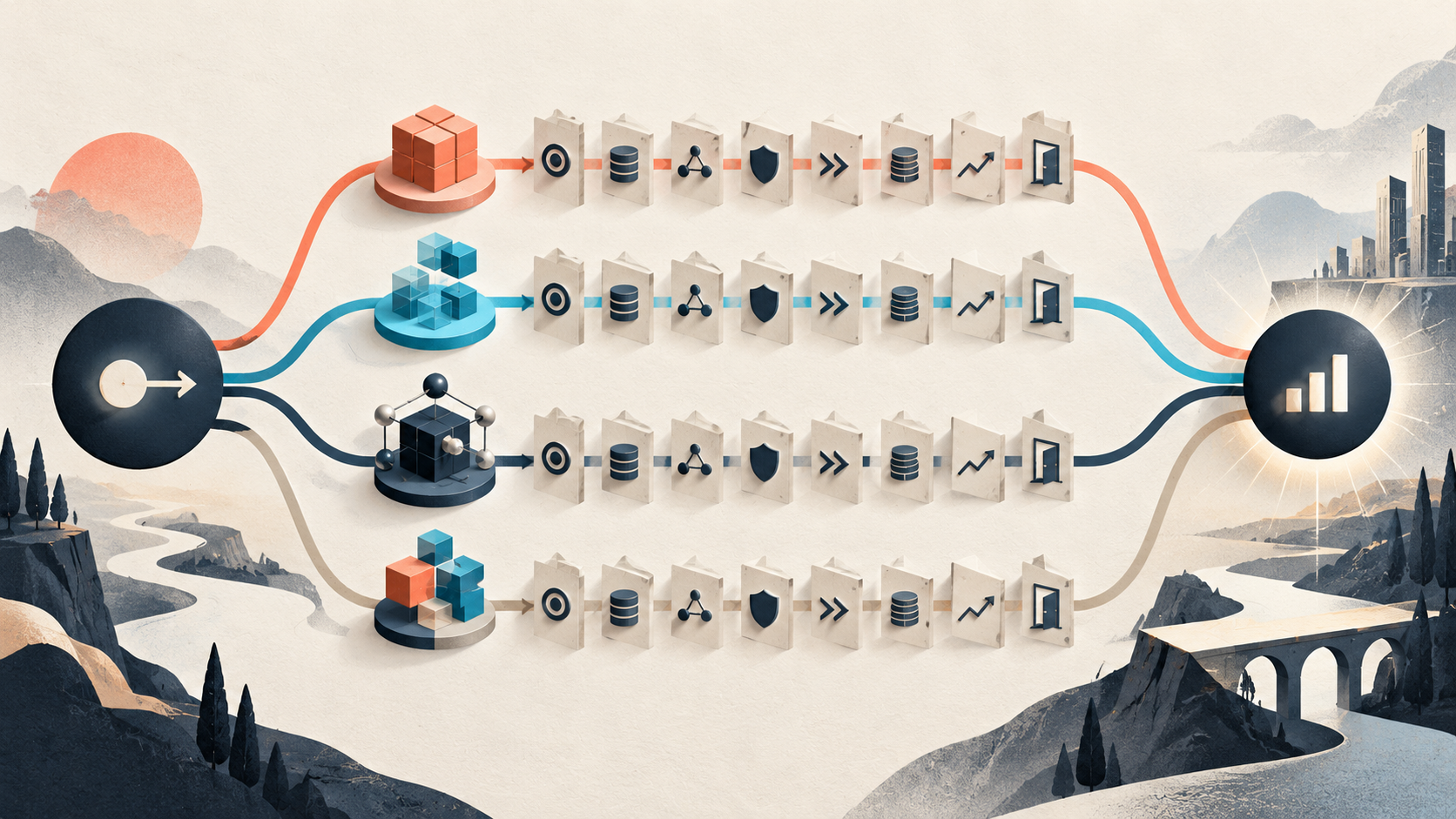
Buy a packaged AI product when the workflow is reasonably standard, the offering meets critical requirements, and speed matters more than differentiation. Configure a platform when reusable services cover the foundation but data, workflows, integrations, and controls need adaptation. Hire a company to build custom when the process is distinctive, changes often, and requires deep control over experience, data, decisions, and architecture.
For many enterprises, the answer is hybrid: market models and services with a company-owned layer for data, orchestration, evaluation, integrations, and experience. The decision should identify which layer must remain differentiating and controlled—not force the entire solution into one commercial category.
The AI Solution Sourcing Fit-8: 32 points before choosing
Score each dimension from zero to four for every route: zero is incompatible; one is an unsupported promise; two is partial; three meets the need with manageable gaps; four meets it with relevant evidence. As a planning guide, require at least 24 of 32, no zero, and at least three in risk, data, and operations. Tailor the threshold to criticality.
- Differentiation — whether the process, experience, or decision creates defensible advantage.
- Functional fit — coverage of critical requirements without fragile workarounds.
- Data and control — access, residency, training use, retention, rights, and traceability.
- Integrations and actions — depth across systems, identities, permissions, and human operations.
- Risk and accountability — security, quality, compliance, explainability, and stop authority.
- Speed and capability — time to value, internal skills, dependencies, and adoption.
- Lifecycle economics — implementation, license, consumption, people, change, support, and exit.
- Adaptability and reversibility — evolution, portability, component replacement, and transition.
When to buy packaged AI
Buy when the outcome is common across the market, the workflow can adapt, risk is bounded, and integrations are shallow. The benefit is faster deployment with less owned maintenance. The trade-off is accepting the vendor's roadmap, configuration boundaries, commercial model, dependencies, and controls.
Test more than the demo. Use representative data, real roles, exceptions, language, volume, security, and an end-to-end journey. Verify export, logs, administration, support, and growth economics. A low seat price can produce a high cost per accepted task when quality gaps create rework.
When to configure a platform
Configure when a platform supplies capable model, retrieval, agent, evaluation, security, and observability services while value depends on assembling them around your workflow. This route accelerates the foundation without making the buyer maintain every infrastructure layer.
Determine whether configuration means composable APIs and versioned components or accumulated proprietary customization behind a closed console. Require separate environments, automated tests, controlled promotion, reproducible configuration, export, and clear accountability among platform vendor, implementation partner, and buyer.
When to hire for custom development
Custom development is justified when the system encodes workflows, data, journeys, or decisions that should not be compressed into a generic product. It also fits AI that must act across systems, combine people and automation, apply specialized controls, or evolve through operating feedback.
Custom does not mean training a foundation model from scratch. A partner can build the differentiating layer with third-party models, cloud, and open components. The agreement should separate owned assets from dependencies and secure repositories, documentation, evaluations, telemetry, rights, environments, and transition capability.
When hybrid is stronger
Use hybrid when layers have different economics: buy commodity capability; configure services that vary by business unit; build the experience, orchestration, and controls that differentiate; preserve interfaces for model and vendor replacement. Give every boundary and lifecycle decision a named owner.
Require four comparable artifacts
- Fit-gap map: critical requirement, native coverage, configuration, development, workaround, evidence, and owner.
- Three-scenario TCO: base, growth, and stress, including licenses, consumption, implementation, operations, people, change, and exit.
- Responsibility map: accountability for data, quality, security, integrations, support, incidents, and evolution.
- Reversibility test: export data and configuration, replace one component, and transfer operations.
Request the same artifacts from product vendors, integrators, and custom-development firms. Normalize volume, quality, timing, and buyer-capacity assumptions. Otherwise the subscription looks artificially simple and custom delivery artificially expensive because each proposal prices a different boundary.
Compare total lifecycle economics
FinOps guidance recommends estimating AI costs across development, pilot, and production and across deployment models. Use business units such as accepted task, resolved case, processed document, assisted sale, or reviewed decision. Include tokens, calls, retrieval, storage, observability, evaluations, environments, support, people, and rework.
Include the cost of change. A product may require process redesign; a platform needs configuration and governance; custom software needs ongoing product and engineering ownership. Promotional credits and launch pricing are not scale scenarios. Neither is waiting months to build a layer that creates no differentiation.
Run a 90-minute sourcing defense
Give finalists the same case: three legacy systems, sensitive data, multilingual operations, a fivefold volume increase, and a required primary-model replacement. Ask them to draw the buy-configure-build boundary, demonstrate one risk control, identify the dominant cost, and execute a component swap. Score the decision, not the quantity of technology.
Five warning signs
- The provider recommends its category before understanding the outcome and workflow.
- The business case omits operations, evaluation, integration, adoption, or exit.
- Customization disguises a structural product gap.
- A proprietary architecture is called an accelerator without portability evidence.
- The buyer will not control raw data, repositories, documentation, telemetry, or decision rights.
U.S. context and connected decisions
For U.S. buyers, compare the contracting entity, data locations, state and sector obligations, subcontractors, accessibility, insurance, support coverage, and customer commitments. Procurement can transfer work but not executive accountability. Security, privacy, legal, finance, data, product, and operations should approve the intended boundary.
Use https://makinai.co/insights/en/in-house-ai-team-or-ai-consulting-firm for internal capacity, https://makinai.co/insights/en/how-to-choose-enterprise-ai-platform-company for platform selection, https://makinai.co/insights/en/how-to-choose-ai-integration-partner-enterprise-systems for integration, https://makinai.co/insights/en/how-to-assess-ai-vendor-lock-in-exit-plan for reversibility, and https://makinai.co/insights/en/how-to-run-paid-ai-pilot-before-hiring-partner for validation.
When to involve MAKINAI
MAKINAI can turn a use case into comparable requirements, map fit and gaps, model lifecycle economics, define the owned boundary, and run a short proof before award. Explore https://makinai.co/services/en/ai-strategy-transformation-consulting. The aim is to build what differentiates, buy what already works, and preserve room to evolve.