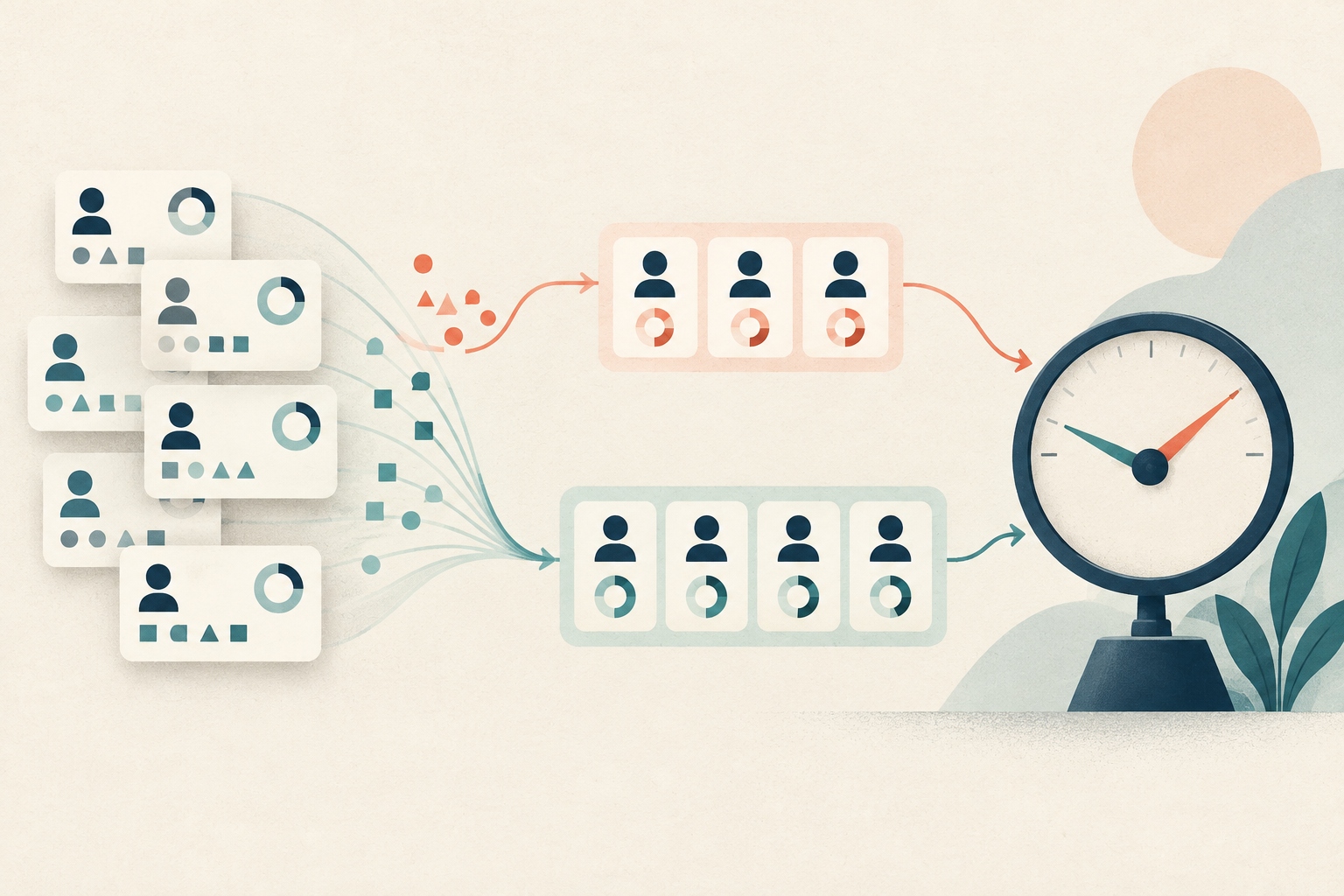
Start with previous customers who are overdue for a plausible repeat purchase and eligible for marketing contact. Use AI to test timing or relevant content, while keeping contact permissions, offer limits and stop conditions in auditable rules. Compare the proposed workflow with your current process and, where feasible, a group that does not receive the win-back intervention. Scale on incremental contribution margin after costs, not attributed email revenue or the number of personalized messages.
Define one repeat-purchase problem
A monthly pet-food customer and a household that bought a refrigerator should not share an inactivity threshold. Choose a category with a credible repeat cycle. Reconcile completed orders and returns, then investigate stock availability, delivery failures, support issues and changing interest. An algorithm cannot repair a poor product experience. If stores and ecommerce do not recognize the same customer, identity resolution may be the investment you need first.
A practical decision sheet: audience, reason, action, evidence
- Eligible audience: prior purchasers, category-specific purchase cycle and permitted channel; exclude recent buyers, unresolved support cases and conflicting campaigns.
- Reason to act: replenishment delay, product-use question or category interest; mark what is observed versus inferred.
- Allowed action: useful reminder, approved educational content, available product suggestion or human assistance; incentives need a separate margin rule.
- Evidence: contribution per eligible customer, observation window, comparator, operating costs and a named decision owner.
This is a MAKINAI working sheet, not a maturity score or a certified method. Each field needs a source and an owner. Avoid sensitive inferences or messages that pretend to know someone's personal circumstances. When the data cannot support a specific recommendation, use a relevant generic message or do not contact the customer.
Separate automation from prediction and generation
Rules should handle permission, frequency caps, fulfillment status, stock checks and stopping after purchase. A predictive model can estimate repeat-purchase timing; generative AI can draft from approved product material. Neither needs authority to invent an offer. Klaviyo documents next-order predictions based on customer and account purchase history, subject to data requirements. A likely buyer is not necessarily someone whose behavior your campaign will change.
Compare a rules-based workflow in your current CRM, an available native predictive feature and a custom model. Rules are easier to inspect. Native predictions may reduce engineering effort but inherit product and data limitations. Custom development requires a distinct unmet need and ongoing support capacity. A CRM replacement should not be a prerequisite for answering this narrow business question.
What the workflow could look like
Hypothetical example: a personal-care brand identifies replenishment customers beyond their usual purchase interval. It checks stock and open service cases, prepares an approved product-use reminder and sends through a permitted channel. A purchase stops the sequence; a complaint goes to a person. A discount is not the default next step. Any incentive becomes a separate test with explicit unit economics. This example is an illustration, not a client case or measured result.
Buy a bounded implementation, not a personalization platform
- Discovery: one category, market and channel, with a documented repeat-purchase baseline.
- Build: customer identity, orders and returns, product availability, exclusions, messages and decision logs.
- Evaluation: approved content, test records, persistent experiment assignment and order reconciliation.
- Operations: workflow owner, exception queue, monitoring, pause procedure and documentation your team can use.
Lifecycle marketing owns the journey; engineering owns integration reliability; customer service owns escalations; finance defines contribution margin. One person remains accountable across the boundaries. Test a purchase mid-sequence, an unsubscribe, duplicate orders, unavailable products and delayed data. HubSpot's workflow testing documentation illustrates checking enrollment and paths before activation. Passing those checks is operational readiness, not proof of revenue lift. Launch a small supervised cohort before wider sending.
Measure the campaign and AI separately
If sample size allows, randomly assign eligible customers to three stable groups: no new win-back intervention, the existing rules-based flow, and the AI-assisted flow. Keep transactional communications and support intact. The first comparison measures win-back impact; comparing rules with AI isolates the incremental value of the AI-assisted approach. With fewer customers, prioritize one question in a two-arm test. Keep other marketing exposure comparable and record overlaps. Analyze everyone assigned, not only people who opened a message.
Klaviyo's documented global holdout feature requires at least 400,000 profiles and tests broader messaging exposure. It is not automatically a suitable single-flow experiment for a midsize company. Confirm that your stack can maintain a localized control group and consistent exclusions. Required sample size depends on baseline conversion, variance and the smallest commercially useful effect. Set duration around buying and return cycles rather than promising an answer in thirty days.
Build an investment case from contribution, not opens
Subtract average contribution per eligible customer in the comparator from that in the new flow, then multiply by the comparable eligible population. Deduct incremental messaging, model, review and operating costs plus an agreed allocation of implementation spend. Include returns, incentives and variable fulfillment costs in contribution, without counting any expense twice. Attributed revenue and experimentally estimated incremental revenue are not additive.
Illustration only: the new workflow produces $18 in contribution per eligible customer versus $16 under current rules. Across 2,000 comparable eligible customers, that is a $4,000 difference before $1,500 of additional costs, leaving $2,500. This arithmetic establishes neither statistical significance nor implementation payback. A wide uncertainty interval or a negative result is a reason to reconsider, not extrapolate.
Ask for separate costs for data cleanup and connections, incremental licenses, workflow setup, content review, measurement and ongoing support. For a US retailer, specify DTC versus marketplace order coverage, fulfillment costs, state or region differences and whether subscriptions already generate reminders. Email and SMS are separate channel decisions with their own permissions and economics; an email subscription is not a blanket permission for every channel. Use your privacy and legal teams for the actual operating requirements.
Bring one workflow to the conversation
Prepare with https://makinai.co/insights/en/assess-data-readiness-before-hiring-ai-company and https://makinai.co/insights/en/evaluate-ai-consulting-roi-business-case-before-hiring. For new inbound demand rather than existing customers, see https://makinai.co/insights/en/ai-lead-qualification-marketing-sales-handoff. MAKINAI's CRM consulting connects lifecycle strategy, data and implementation: https://makinai.co/services/en/crm-ecommerce-commerce-transformation. Bring one category, the current journey and anonymized reasons customers stop buying. We can discuss whether a better rule, an integration or an AI test is the next useful investment.
The sources support individual capabilities and safeguards, not a forecast of sales uplift. NIST's Generative AI Profile informs content-risk review; it does not certify this workflow. The decision sheet, implementation scope and hypothetical economics are MAKINAI editorial recommendations.